What is the relative value of Bob Cratchit’s 15 shillings a week in 1843?

In Charles Dickens A Christmas Carol, Ebenezer Scrooge paid his clerk Bob Cratchit 15 shillings a week. What is the present-day equivalent of those 15 shillings? The MeasuringWorth comparator gives two answers.

In 2020, the real wage value of 15 shillings from 1843 is £75.28.
In 2020, the relative labour earnings value of 15 shillings from 1843 is £611.30

Why are they so different and what do they mean? The reason is that they are answers to two quite different questions. While they are both measured in British pounds, they should NOT be compared to each other.

The real wage is computed using a retail consumer price index of a basket of goods and services. In principle, by inflating the collection of goods (e.g., a goose) the average family could buy with 15 shillings, the index says that would be similar to a collection of goods an average family in today’s London could buy with £75.28. This is a totally unrealistic number!

Today a family of six could not afford the groceries to make a Christmas dinner for £75.28, let alone live for week. If we assume that Cratchit worked 10 hours a day for six days each week, that £75.28 rate would be £1.26 an hour. The current national minimum or living wage rate in the UK is £8.91 per hour. Even for workers under the age of 18 it is £4.60.

Price indexes do not reflect the actual increases in the cost of living over long periods of time because the market baskets purchased by representative consumers have changed so much. For example, food purchases constituted roughly 50% of the index in the 1840s; food is less than 10% today.* The Cratchits could not have purchased most of the goods in today’s basket because they didn’t exist in 1843.

The relative labour earnings is computed using an index of average earnings paid to workers. Thus, the “relative” wage of a worker who earned 15 shillings a week in 1843 is £611.30 today. At 52 weeks of work, that would correspond to about £32,000 a year. Bob Cratchit was responsible for maintaining Scrooge’s account books. The average UK accountant today earns a salary of £62,042 per year; the average bookkeeper, £26,848 per year. While Cratchit’s job may not have required a CPA, it involved much more than the tasks required of the average bookkeeper today. The fact Scrooge was paying Cratchit an amount slightly above that of an average bookkeeper speaks to Scrooge’s miserliness.

*The CPI and RPI are better designed to compute inflation rates than the “cost of living” over long periods on time.
The Ups and Downs of Gasoline Prices

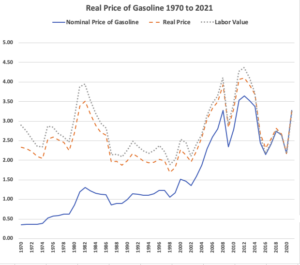
The ups and downs of gasoline prices this year has seen a 50% increase in gasoline prices over a year ago.*  Is this a record increase? Are prices at an all-time high?  The answer to both those questions is NO.

The rapid increase has come from weather-created supply problems, OPEC and Russia agreeing to restrict their output, and that prices that were unusually low due to the COVID-caused dip in price last year where a gallon of regular gasoline fell from $2.90 in May of 2019 to $1.88 a year later. Comparing the current price of $3.36 with the pre-COVID price, the increase was 16% over two years, much less than the 50% of the past year. While the latest increase has been hard on the budget, it has not been unique, as the years of 2000, 2005 and 2010 all had one-year increases of over 55%.

This century started with the price around a $1.50 per gallon and for the next eight years it went up over 10% a year, mostly a result of the wars in Iraq and Afghanistan. It peaked with the highest average monthly price ever of $4.09 in June of 2008. That was just before the Great Recession; five months later it had dropped close to 60% to $1.69. I am sure no one wants us to have a recession now just to have lower gasoline prices.  The longest period of high gasoline prices was from January 2011 to October 2014. During that 44-month period the average monthly price of gasoline was $3.55 and it never was less than $3.00.

The more interesting questions are what are the real costs of filling up and how has that changed?  In MeasuringWorth we have several different ways of describing a price of a commodity in the past. For this discussion I will use the real price that corrects for inflation and the labor value that holds constant the relative share of a worker’s pay it takes to buy the same amount of an item.

Correcting for inflation is what the standard inflation calculators do. The real price of gasoline in the past is more than today’s observed price because all prices have gone up, so we “correct” for how much gasoline costs compared to all the other things we are buying. For example, if gasoline cost $1.00 in 1990 and $3.00 today and at the same time food, clothing, rent and every else we buy also has gone up 300%, we would say the real price of the gasoline had not changed — the real price of gasoline in 1990 was $3.00 in today’s dollars. The real price, however, does not measure the “affordability” of gasoline. It does not compare that price to the income of those who are buying it.

The labor value measure shows what the price of gasoline would have to be today to take the same share of a worker’s pay as it did some year in the past.  For example, if in the year 1990, the average price of gasoline was $1.00 and the hourly wage of a production worker was $10.00, a gallon cost 10.0% of an hour’s work.  If today that wage index is $33.00, 10.0% of that is $3.30.  So, the labor value of a gallon of gasoline in 1990 is $3.30 in today’s dollars.

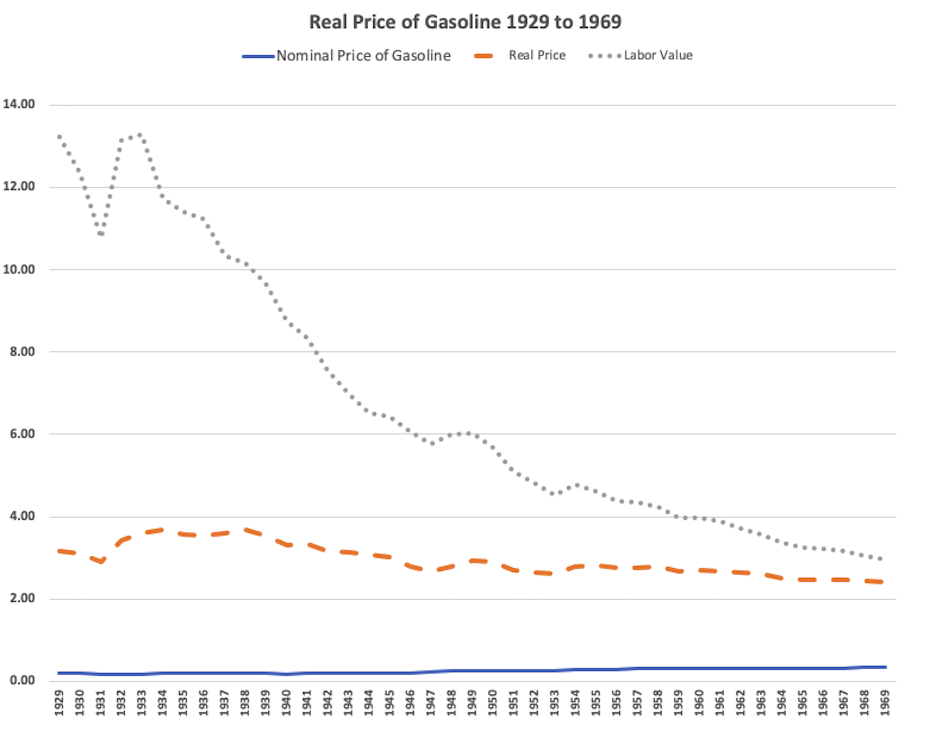
Below are charts of the price of gasoline at the pump, its real price and its labor value.  Notice that for this century, the real price and labor value have moved closely together. This reflects that real wages have not increased very much for the last 20 years.

The 40 years from 1929 to 1969 show a couple of interesting things. During the years of the Great Depression the real price was around $3.60 a gallon.  Then during WWII with rationing and price controls it fell to $2.60 a gallon. For the next 20 years it remained relatively constant.  At the end of the War, price controls and rationing ended and the price moved up to 27¢ in the next three years, then for the next 30 years it increased at a stable half-cent a year.  For a short period, oil prices were driven by the politics of the Organization of Petroleum Exporting Countries (OPEC), but they did return to the long run trend.  For the 25 years from 1975 to 2000, we can see the impact of the inflation of the 1970s as the real price and labor value compared to the nominal price are greater than before.

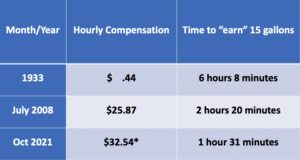
The more interesting number is the labor value. In 1933 the labor value of a gallon gasoline in today’s dollars was $ 13.28, the highest in all 92 years period. So, the next time you grumble about paying $50 for 15 gallons, think of your grandparent paying $200, four times as much with respect to what they earned.

* All prices in this article are of a gallon of regular gasoline as reported by U.S. Energy Information Administration who have published annual prices from 1929 to today.


“What the Tulsa Race Massacre Destroyed” — A lot more than what the New York Times says.

The New York Times (May 25, 2021)  has published an article titled “What the Tulsa Race Massacre Destroyed.”* The article is a masterful presentation of graphics that give a wonderful feeling of what Greenwood, the prosperous black neighborhood in Tulsa, was like in May of 1921.  The article started out saying “The Tulsa Race Massacre of 1921 killed hundreds of residents, burned more than 1,250 homes…” Three paragraphs later it states that on one destroyed block “there were four hotels, two newspapers, eight doctors, seven barbers, nine restaurants and a half-dozen professional offices of real estate agents, dentists and lawyers.”  That was just one block among many destroyed.  The story of the destruction of life and property in the first two days of June one hundred years ago is tragic and makes one want to think “if only this did not happen, what would the back community of Tulsa accomplished?”

The article has nine authors and three pages explaining their methodology.  There are 20 different sources and 14 other people listed as assisting in the production. It was a big undertaking and very impressive.

So why can’t the New York Times learn how to measure relative worth?  In the fifth paragraph of the article it says: “The financial toll of the massacre is evident in the $1.8 million in property loss claims — $27 million in today’s dollars —”

This number come from one many cost of living or purchase power calculators that one finds on the internet.  Except for ours, they all use the CPI to inflate a value from the past and in most cases the answers are one dimensional and misleading.  In this case, the error is spectacularly bad.  A quick consideration of replacement costs shows this.

For example, 27 million divided by the 1,250 homes comes out to $20,000 a home and that does not take into account all the business lost. A simple search of google asking “what is the cost of building a new hotel?” gives the following answer:  “The national average range is $13 million to $32 million with most people spending around $22. 1 million on a 3-star hotel with 100 rooms.”  Restaurants and office buildings might cost from $250 to $500 a square foot to build. The article says that some half a dozen churches were burned, one of the was large brick Mount Zion Baptist Church, which one can imagine would take tens of $millions to re-build today.  Remember that Greenwood not only lost buildings, but also water, sewer and power utilities.

The MeasuringWorth relative worth comparator, Purchase Power Today of US Dollars, gives seven choices for the relative worth of a financial amount in the past.  They range from $21 million to $534 million and are measured using price, income, household expenditures and output indexes.

There is no doubt that the output measure should be used to measure the relative value of this $1.8 million in 1921.  What the comparator shows is that in 1921 the share that $1.8 million was of the GDP is the same as the share $534.06 million is of GDP today.  Another way to put it is to say if we spent over $0.5 billion on restoring the Greenwood neighborhood today, it would represent the same percent of the economy’s output that was destroyed a hundred years ago.

A second best choice for the relative worth would be to use the wage measure and that would say $1.8 million in 1921 has a relative wage of $149.14 million in wages today.  This can be interpreted as saying it would take this much to hire as many workers today as the $1.8 million would have hired then.

This is not the first time the New York Times has used inflation calculators to come up with very bad estimates of relative worth.  Part of the blame may be search engines that lead to calculators that “adjust for inflation” simply by using the CPI and lead users to believe there is one definitive answer.  Unfortunately, lots of economists do the same.

Please do not use the comment box below.  You can send me an email at sam@mswth.org if you wish.

  • The New York Times may not allow you to connect from the link here.  The address of the article is: https://www.nytimes.com/interactive/2021/05/24/us/tulsa-race-massacre.html

Comparing the Government Expenditures on WWII to the Covid Stimulus Packages. $24 trillion is better number.

The March 11th column by David Brooks in the New York Times stated that:

“As Michael Hendrix of the Manhattan Institute notes, America spent $4.8 trillion in today’s dollars fighting World War II. Over the past year, America has spent over $5.5 trillion fighting the pandemic.”

This is the worst possible use of using the CPI to compare relative worth (See the essay on this issue on our website.)

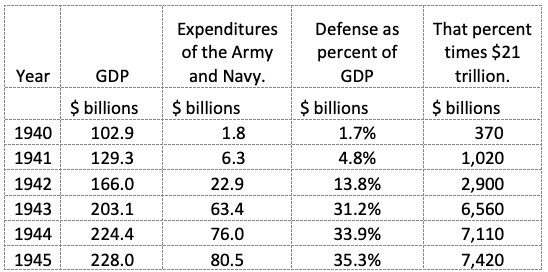
It makes far more sense to use the GDP to compare these expenditures. This table shows the GDP and armed forces expenditures for the war years in current year values. The third column reports those expenditures as a percent of GDP. The last column is that percent times the today’s GDP of $21 trillion.

For three years the war expenses are over 30% of GDP . If we take the relative GDP share of these expenditures during the four years from 1942 to 1945, the total of those numbers is $24 trillion, four times the $6 trillion to be spent on relief today.

WWII was a period in our history where this country expended more of its resources and suffered more sacrifices to defeat an enemy than any time since the Civil War. It is ridiculous to compare it to the outlays today.

The Relative Performance of the Economy under the Presidents of the United States from 1900 to 2020

As an economic historian and a political junky (I have buttons I wore during the 1952 Presidential campaign) I am always a bit frustrated when people are blaming or giving credit to an incumbent president for the state of the economy.  While sometimes it is true, the causes of the movement of the economy are more complicate than the activates of one agent.  It is the same as measuring relative worth.

I have written an essay titled  The Relative Performance of the Economy under the Presidents of the United States from 1900 to 2020.  What I do is compare the performance of several aggregate economic variables over the different administrations. The goal of this new essay on our site is to help the reader better understand how the economy performed during each of the presidential terms from 1900 to 2020.

NYC skyrocketing real estate prices in the 19th century.

QUESTION: In the MeasuringWorth website, in what category would land prices fall? Just doing the Commodity real value exchange doesn’t seem to factor in the skyrocketing New York City real estate prices in the 19th century, which is my concern.

ANSWER: As we try to explain, questions of relative worth depend on the context. If you were talking about land prices today, what would you be comparing them to? Would it be the cost of a bundle of consumer goods?  Probably not, so the same would apply to the 19th century as you suggest.

Those who I know that own or are looking to own in NYC these days think about two things, what the total monthly mortgage, tax, etc. payment will be (very dependent on interest rates), and the share that payment is of their income.

There are other ways of looking at the question that might use other indexes.  You can check out our tutorials.

Republicans raise nearly $5 billion to elect the President — in 1896.

QUESTION: In 1896 the McKinley presidential campaign spent at least $3.5 million. In 2016, Trump and Clinton spent about 2.4 billion. What calculation would you use–purchasing power, size of economy–to determine which was the most expensive campaign?

ANSWER:  To start with, the $3.5 million was only what the campaign raised. One of McKinley’s biographies quoted in Wikipedia reports that by including fundraising by state and local committees,  “Estimates of what Republicans may have raised in total have ranged as high as $16.5 million.” As an aside, J.D. Rockefeller himself donated $25,000, a relative income value of about $7 million today.

McKinley ran the campaign from his front porch in Canton, Ohio; he did not go to rallies or take whistle-stop train trips. Much of the money was spent on printing pamphlets and hiring hundreds of stump speakers to campaign on his behalf. We can think of all these stump speakers as the 1896 version of today’s TV ads. (At least then you could choose not to go hear them instead of having them in your living room 24 hours a day.)

The relative value of $3.5 million today using the CPI index is $108 million; for $16.5 million, it is $509 million. If campaigns then and now spent most of their money on printing, then that would be a reasonable measure, although looking at relative printing costs would be better. Printing, however, is a very small cost of campaigns today.

Today’s campaigns pay millions for ads on TV and social media as well as rallies and personal appearances. I am going to guess that TV ad rates are proportional to the cost of producing them and that cost is proportional to the skilled wage. In 1896, the campaign was spending large amounts hiring stump speakers and their cost would also be proportional to the skilled wage. So if we look at the relative values of $3.5 million and $16.5 million using the production worker compensation index, we get totals of $877 million and $4.7 billion, respectively.

We do not know how state and local Republican committees spent their funds; it could have been support for McKinley or candidates for other offices. In any event, we have that the McKinley presidential campaign raised close to a relative worth today of nearly $5 billion for the 1896 election.

Value of Canadian Debt

QUESTION: I’m trying to determine the actual value of 6 000 000 CAD$ of public debt in 1941. Since you have references for only US, UK, Australia and Spain, I figured relative output/economic cost for any of those nations does not work since it’s not relative to Canadian GDP. What do you suggest?

ANSWER: If the relevant data isn’t on MeasuringWorth, one has to look elsewhere, in this case Statistics Canada and the Historical Statistics of Canada, both of which are online.  For example, if one looks at GNP at market prices, the ratio of that figure in 2018 to 1941 is roughly 200.  Assuming the $6 mil Canadian public debt is a nominal figure, that compares to $1,200 million Canadian today.  But, more to the point, if users identifies the measure(s) to use, then they need to find the relevant statistics for the chosen years and do the calculation themselves.

How can I compare donations to universities over time?

QUESTION:  I wish to compare the relative value of several large donations made to American universities between 1829 and 2015. Most of these were bequests and the funds were used for both operating expenses as well as the construction of new facilities. There is no indication of the relative “split” and clearly it will vary with the individual circumstances of the receiving institution. If it cannot be determined what the bequest was used for — which is the case here — what criteria should be used to determine the best method to use?

ANSWER:  You supplied several examples; let’s concentrate on just three:

  1. James Smithson to found the Smithsonian Institution gave $500,000 in 1829.
  2. Stephen Girard bequeathed $2,000,000 to a number of education causes in 1831.
  3. John Hopkins gift of $7,000,000 in 1873 was used to found a University bearing his name.

A price index would not be very useful since the commodities bought then and now are so different.  If we knew how much of each was used for construction costs, then using one of the wage series might provide a useful comparator.

Because the gifted funds were used to purchase both consumer and producer (capital) goods, the two choices I would recommend are 1) the income value (using the relative GDP per capita) and 2) the economy share (relative share of GDP).  The first is a more general measure of how the gifts compare to the average earnings of the day. The second shows their relative value to the economy at the time.

For Smithson, the relative value in 2018 for each of those two values is $420 million and $11 billion.

For Girard, they are $1.6 billion and $39 billion.

For Hopkins, they are $2.1 billion and $16.2 billion.

By comparison, Michael Bloomberg has given $3.3 billion to John Hopkins over the years; the Bill and Melinda Gates’ foundation is worth around $50 billion.

How do we compare rich people over time.

Hello. We are a newspaper based in Barcelona, Spain, founded in 1881. We are writing an article about the wealthiest people in history, inspired by an article in Bloomberg Businessweek on May 21st citing your site. I would like follow up that pieces with a few questions to help us with our article. Thank you in advance.

QUESTION  1,  Is the ratio of wealth to GDP the best way of comparing fortunes through history? Which are the main alternatives?

ANSWER.  It is the most often used and has the advantage of not having to deal with the mix of output.  (There were no antibiotics available to the richest person on earth before they were invented.)  By using the share of GDP index you are comparing what we call the “economic power” of the individual.  That power can be used in the market to control the use of resources.  Of course absolute monarchs have this power and do not have to use the market, so in some sense the size of their wealth is not as important as their power to expropriate.

QUESTION 2.  Can we consider John D. Rockefeller as the wealthiest person in history? Some rankings cite Genghis Khan, for example. Do you consider this kind of rankings as accurate? Can we really compare wealth through history or we have to limit it to its context?

ANSWER: It is useful in comparing two private individuals that have a large amount of wealth in a market economy and cannot expropriate for comparison over time.  Using a wage or income index could also be instructive. We seem fascinated at how much more CEOs make today as a proportion of their workers.  It could easily be of interest in the past.

As for Genghis Khan, he was an absolute ruler, he did not need monetary wealth to command resources, so I do not see an easy way to compare him with Rockefeller.  Perhaps with Alexander the Great?  And then there is Gaius Appuleius Diocles, the Roman chariot racer who was regarded as the richest athlete in history and perhaps the richest person in the Roman Empire.  How do we compare him?