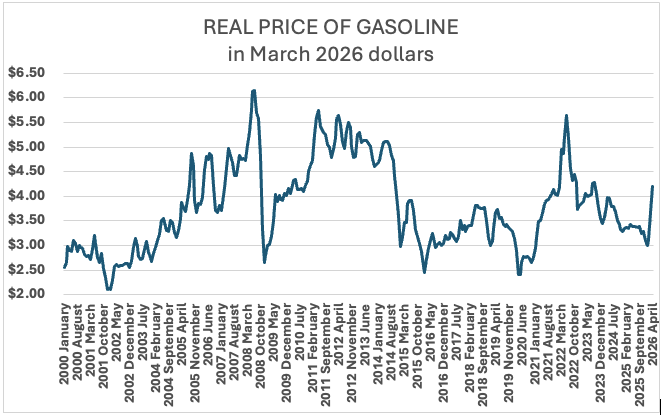
The “real” price of gasoline: Gasoline cost 22 cents a gallon in 1929 compared to a (nominal) peak of $5.05 in June of 2022 (it had dropped since.) How has the relative cost of buying gas changed over the last 90 years? Presented here are two tables computing the annual “real” cost using our seven indexes, one in 2025 dollars, and the other in 1929 dollars. While the two tables show the same trends, they do give a different perspective.
Using the 2025 table and the CPI and the GDP deflator, we see that gasoline was most expensive in 2022 and it was the cheapest in 1998. In 2025, the real price using these two measures is 156% and 177% higher than in 1998 and 72% and 74% cheaper than 2022.
By looking at the share of the Consumer Bundle and GDP per capita, the story is a bit different. In 1931, the “real” price of Gasoline was $3.59 using the CPI, however, a gallon of gas took as much out of what the average consumer spent as $8.73 did in 2025. And as a share of GDP per capita, gas was even more expensive in those earlier days as it was over $24.54 in 1931 and as much as $9.30 in 1960.
The other table tells the story in a different way. Let us look at relative cost to a worker to fill up using 1929 dollars. That year the 21 cents it cost for a gallon of gas, took a certain share of the worker’s wage. The interesting question is, has the cost as a share or percent of the worker’s wage increased or decreased over time? The table shows that for the wage rates and price of gasoline in other years; this cost has fallen. Since wages have increased faster than the price of gasoline, by 2025 the wage indexes show that workers spend less than one-fourth as much, as a percent of wages, for a gallon of gasoline than the 1929 worker. The table shows that the $3.26 a worker paid in 2025 would be comparable to 5 cents (in 1929 prices “share” of the wage.)
When we use the GDP per capita, the cost has fallen faster. Looking at the table shows that a gallon of gasoline today costs around 3 cents a gallon (in 1929 prices) if measured as a “share” of the GDP per capita. This is because in 1929, 21 cents was 0.44% of per capita GDP, while in 2025, $3.26 was 0.0036%.
Finally, comparing its cost as a share of GDP, we see that for 2025 (in 1929 prices), it is about 1 cent. This means that the cost a gallon of gasoline was over 21 times larger as a share of output in 1929 than it is today.